
Have you ever mixed a beautiful pink, green, or blue batter, only to find that the color looks completely different after baking? Or added more natural coloring to get a deeper shade, only to realize that it also changed the flavor or texture?
That is because choosing natural food coloring for baking is not only about finding an ingredient that creates the right color. Heat, pH, dosage, flavor, and moisture can all affect how a natural color performs in the finished product.
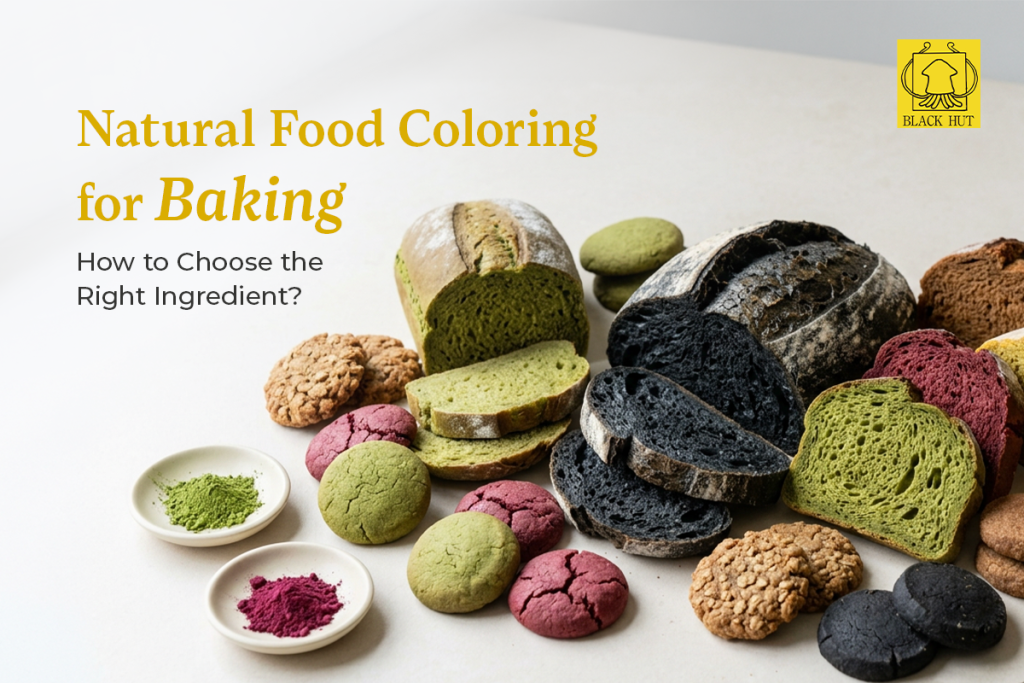
In this guide, we’ll look at common natural coloring ingredients, what happens to them during baking, and how to choose the right option for cakes, cookies, frosting, bread, and savory baked goods. We’ll also take a closer look at natural black food coloring—one of the more challenging colors to achieve naturally.
Table of Contents
ToggleWhat Is Natural Food Coloring for Baking?
Natural food coloring generally refers to colors derived from sources such as vegetables, fruits, plants, algae, spices, cocoa, and other food-derived ingredients.
Common examples include beet powder for red or pink, turmeric for yellow, matcha or spirulina-based ingredients for green, butterfly pea for blue or purple, and cocoa or squid ink for darker colors.
For bakers, the important thing to remember is that a food-derived coloring ingredient is still an ingredient once it enters your recipe.
Unlike a color that only changes appearance, natural coloring ingredients may also contribute flavor, solids, or moisture. Their colors can respond differently to heat and pH as well.
That means the best natural food coloring for baking isn’t simply the one that creates the brightest shade. It should also work with the flavor, texture, and baking process of the food you’re making.
How to Choose the Best Natural Food Coloring for Baking
There is no single best natural food coloring for every baked product. A bright pink frosting, a green cookie, and a black savory bun all require different things from their coloring ingredients.
Before choosing one, consider these four factors.
1. Check Color Stability After Baking
The color you see in raw batter or dough may not be the color you get after baking. Natural pigments can react differently to heat, pH, and browning. For example, anthocyanins found in many red, purple, and blue foods are sensitive to heat and acidity, while phycocyanin from spirulina can lose stability at higher temperatures.
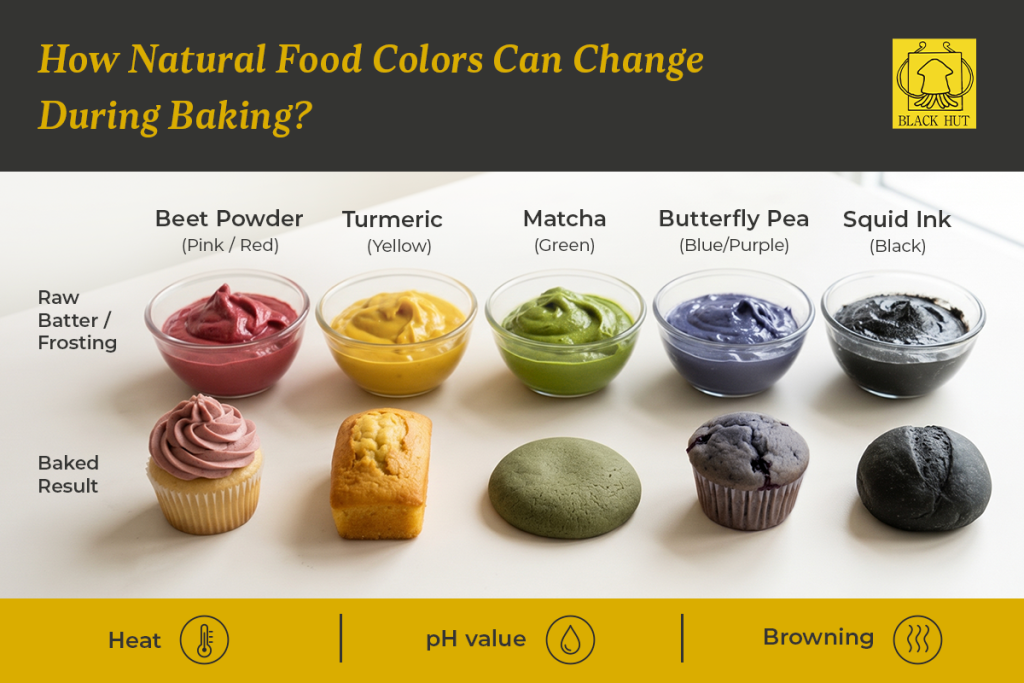
What’s more, the interior of bread retains more moisture, while the crust is exposed directly to oven heat, faster moisture loss, and stronger browning. This means a deeply colored crumb can still develop a lighter, browner, or more muted crust.
| Factor | What Can Happen During Baking | What to Do |
|---|---|---|
| Heat | Some natural pigments may fade or become duller | Test the color after baking, not only in raw batter |
| pH | Acidity or alkalinity can shift certain colors | Consider acidic or alkaline ingredients in the recipe |
| Browning | Cookies, cakes, and breads may develop brown tones that mask the color | Evaluate both the crust and interior color |
💡 Practical Tip
Don’t judge the required dosage from raw dough alone. Compare the dough before baking with the finished crust and crumb before deciding whether more coloring is actually needed.
2. Consider Flavor Before Adding More Color
Natural food coloring can contribute flavor as well as color.
For example:
- Matcha can add a grassy, slightly bitter character.
- Turmeric can contribute earthy and warm spice notes.
- Cocoa brings an obvious chocolate flavor.
- Beet can add earthy or mildly sweet notes.
- Squid ink contributes a subtle savory, briny, and umami character.
This becomes especially important when trying to achieve a darker shade. Adding more natural coloring may deepen the color, but it can also make the ingredient’s flavor more noticeable.
💡 Practical Tip
Instead of asking only, “Is this color dark enough?” also ask:
“Does this ingredient still taste right at the amount needed to create that color?”
More is not always better. The goal is not necessarily to use the highest amount possible, but to find the lowest effective level that achieves the desired appearance while still fitting the intended flavor profile.
3. Consider Dosage, Moisture, and Texture
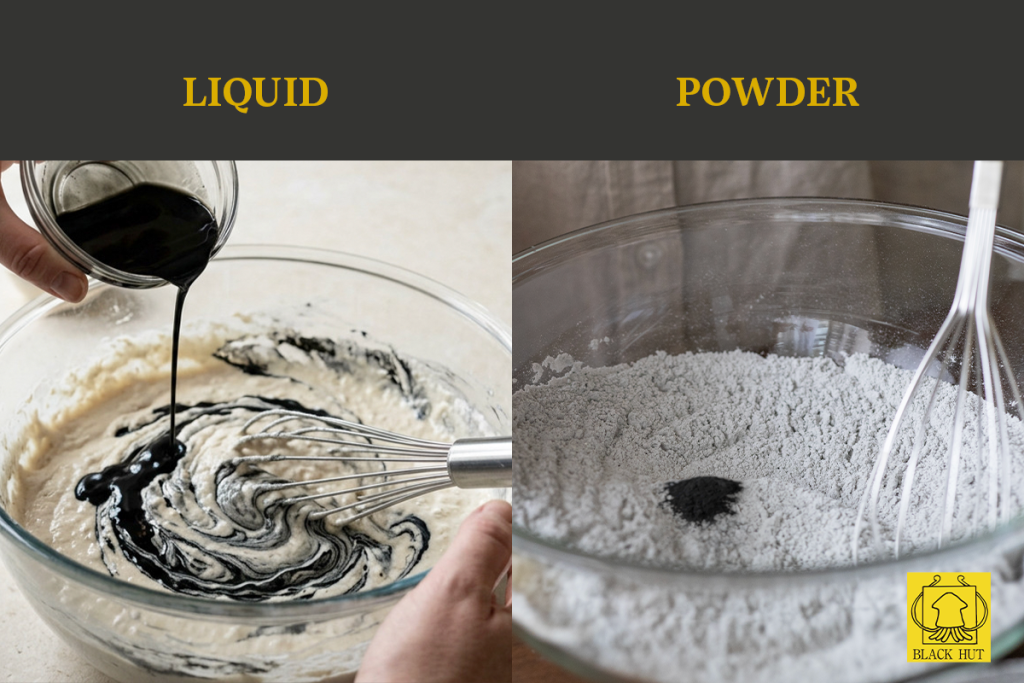
The form of a natural coloring matters, too. Liquid coloring adds moisture, while powders add solids and may change how a recipe handles water. Neither can be treated as color alone.
Squid ink is a good example. Liquid squid ink adds both color and moisture directly to a recipe. Unlike liquid squid ink, the squid ink powder adds no liquid to the formula, but in bread dough it can still affect firmness and hydration as the dosage increases.The same principle can apply to other natural coloring ingredients.
🔬 From Black Hut’s Baking Experience
As a starting point, Black Hut‘s technical guidance suggests testing additional water at approximately 1–1.5 times the weight of the squid ink powder, then adjusting according to the actual dough.
For example, 20 g of squid ink powder → 20–30 g of additional water as an initial trial, not a fixed formula.
So whether you use a liquid or powder, treat the coloring as part of the formula and adjust the recipe when needed.
4. Test Before Scaling Up
Start with a small batch and evaluate the finished product, not just the raw mixture. For commercial production, the goal is not only to achieve the desired color but also to develop a formula that delivers consistent results.
When testing a natural coloring, evaluate:
-
Color: Compare the raw mixture with the finished product, including both crust and crumb where applicable.
-
Flavor: Check whether the coloring ingredient complements the recipe at the required dosage.
-
Texture and moisture: Look for changes in firmness, hydration, and the finished texture.
-
Processing: Observe how the dough or batter behaves during mixing, proofing, and baking.
-
Consistency: Check whether the appearance and quality remain acceptable after cooling and storage.
In Black Hut’s squid ink powder applications, these considerations help guide adjustments to the formula rather than simply increasing the amount of coloring.
💡 Commercial Testing Tip
Before comparing batches, define how the coloring dosage is calculated. For example, if you use a percentage of total dry ingredients, apply that same basis across every trial.
This makes it easier to compare results, reproduce successful formulas, and scale up production.
The goal is to identify whether the next adjustment should involve coloring dosage, hydration, or processing conditions—rather than assuming more coloring is always the answer.
Best Natural Food Coloring Ingredients by Color
Different natural ingredients create different shades—and bring different flavors and baking considerations with them.
| Desired Color | Natural Ingredient | Flavor Impact | Baking Consideration |
|---|---|---|---|
| Pink / Red | Beet powder | Mildly earthy or sweet | Plant pigments can change with heat and pH |
| Yellow | Turmeric | Earthy, warm, slightly spicy | Strong color, but flavor becomes more noticeable at higher amounts |
| Green | Matcha or spirulina-based coloring | Grassy to mild | Some green/blue pigments are sensitive to heat |
| Blue / Purple | Butterfly pea | Generally mild | Color is particularly sensitive to pH |
| Brown | Cocoa | Chocolate | Naturally suited to cookies, cakes, and other sweet baking |
| Black | Squid ink powder, black cocoa, black sesame | Savory, chocolate, or nutty depending on ingredient | Choose based on both the desired shade and flavor profile |
There is no universally “best” natural coloring. A color that works beautifully in frosting may perform differently in a bread dough, while an ingredient that complements chocolate cake may taste out of place in a savory bun.
It is also important for commercial food developers to check the regulatory status and permitted uses of any coloring ingredient in the market where the product will be sold. In the U.S., the FDA maintains specific listings and use restrictions for approved color additives.
>> Learn more about FDA Food Dye Ban 2027: A Reformulation Guide for Food Manufacturers
Which Natural Food Coloring Works Best for Cake, Cookies, Frosting, and Bread?
Instead of choosing natural coloring based only on the shade you want, it helps to start with what you are actually making.
Cakes and Cupcakes
Cake batter goes through both heat and browning, so the color you see before baking may not match the final cake.
For naturally colored cakes, consider:
- how the pigment responds to heat
- whether the batter is acidic or alkaline
- whether enough coloring can be added without creating an unwanted flavor
- the difference between the browned exterior and the interior crumb
When testing a new natural color, cut the cake open before judging the result. The crumb may retain significantly more color than the surface.
Cookies
Cookies often brown during baking, which can make natural colors appear duller than they do in raw dough. However, the result depends on the coloring ingredient and dosage.
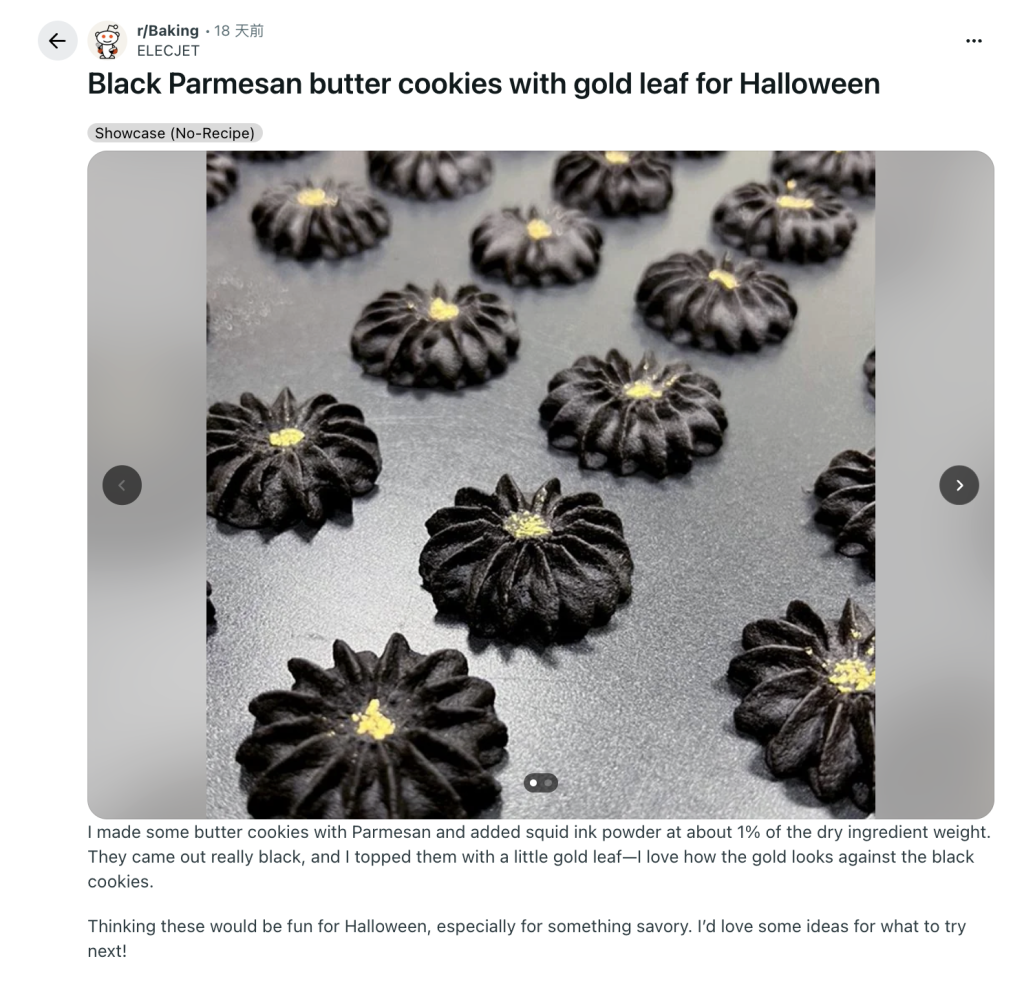
In a real-world example shared on Reddit, a baker used squid ink powder at approximately 1% of the dry ingredient weight to create deep black Parmesan butter cookies. The baker reported that the Parmesan and butter flavors remained dominant, showing how natural coloring can achieve a strong visual effect without overpowering the intended flavor.
Frosting & Icing
Because most frosting and icing are colored after baking, heat stability becomes less important.
Instead, focus on:
- color intensity
- flavor
- smooth dispersion
- consistency
- how the color develops during resting or storage
This is why a natural coloring that performs beautifully in buttercream is not automatically the best choice for cookie dough or cake batter.
Bread and Savory Buns
Bread introduces another variable: dough structure.
When using powdered natural coloring, bakers need to consider how the added solids interact with water, mixing, fermentation, and the finished crumb.
Flavor is also especially important here.
A chocolate-flavored black ingredient may work in sweet bread but not in savory dough. Squid ink powder can be a better fit when both dark color and a savory flavor profile are wanted.
One baker, for example, used squid ink powder at about 1% of the dry ingredient weight to make a black pizza crust with pumpkin sauce, sausage, and cheddar. The finished crust was deeply black, while the baker reported that the seafood flavor remained mild enough for the toppings to stay dominant.

This is a good example of why the right natural coloring depends not only on the desired color, but also on what flavors need to remain at the center of the finished product.
How to Use Natural Black Food Coloring in Baking
Black is one of the more challenging colors to create with food-derived ingredients. Many ingredients produce brown, gray, or purple-black rather than a neutral, deep black, and adding more coloring can eventually change the flavor or formulation.
That makes the intended application particularly important.
Natural Food Coloring for Baking: Black Cocoa, Black Sesame, or Squid Ink Powder?
Black cocoa creates a very dark brown-to-black appearance and naturally brings a chocolate flavor. It is a logical option for cakes, cookies, brownies, and other sweet baked goods where cocoa already fits the flavor profile.
Black sesame can create dark gray to black tones while adding a distinctive roasted, nutty flavor. It works well when sesame is meant to be part of the product’s identity.
Squid ink powder provides another approach for savory applications. Its dark pigmentation is paired with a subtle marine and umami character, making it particularly interesting for savory bread, buns, crackers, and other products where a chocolate or nutty flavor would not fit.
Natural coloring in baking is a formulation problem—not only a coloring problem.
If you want a broader comparison, read our guide to natural black food coloring and why chefs use squid ink for deep color and flavor.
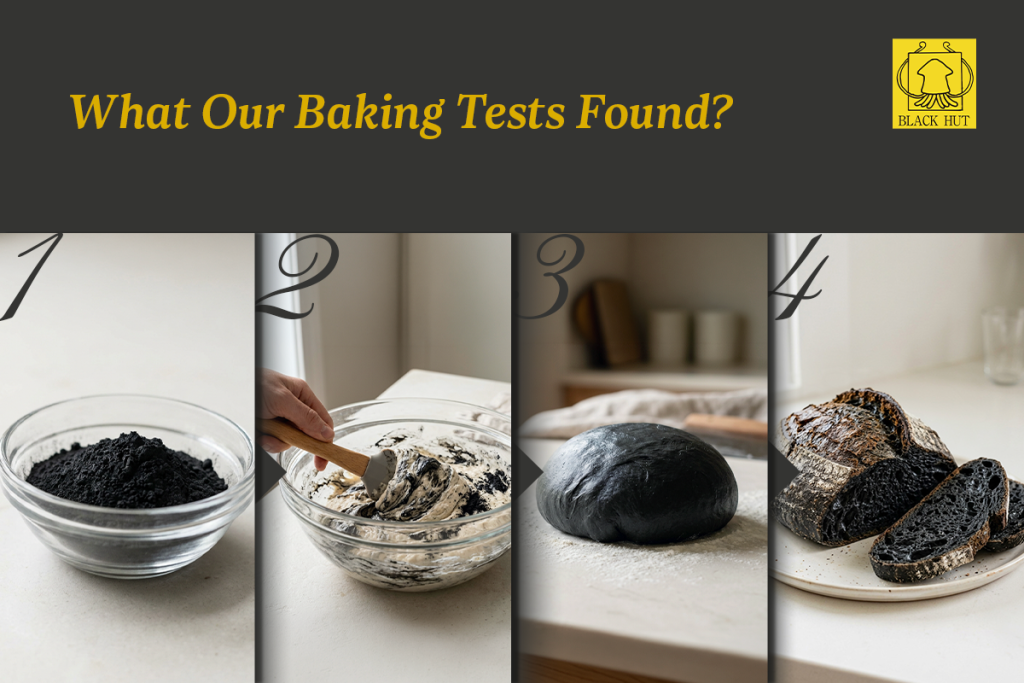
Natural Food Coloring for Baking: What Our Baking Tests Found
Learning 1: Start with a Controlled Dosage Range
For initial formulation trials, 1–3% squid ink powder based on the total weight of dry ingredients can serve as a starting reference. Testing small batches at 1%, 2%, and 3% helps identify the lowest effective dosage for the desired color and flavor.
These percentages are starting points for testing, not guaranteed results. The ideal amount depends on the recipe and intended application.
Learning 2: A Black Crumb Doesn’t Always Mean a Black Crust
In an initial trial shared by a commercial bakery customer, black brioche buns developed a deep black interior, while the crust remained brown to gray-black.
This highlights an important distinction: the color inside a baked product may differ significantly from its surface.
If the crumb is already dark enough, adding more powder may not solve the crust color issue. Instead, consider testing baking temperature, time, surface moisture, steam, airflow, and formulation to understand how they affect the finished appearance.
Learning 3: Hydration Matters as Dosage Increases
Squid ink powder adds solids to the dough and may affect its firmness and hydration, particularly at higher inclusion levels.
As the dosage increases, bakers may need to adjust water content, mixing conditions, and dough handling to maintain the desired texture.
Rather than treating squid ink powder as a final color adjustment, incorporate it into the overall formula and evaluate how the dough behaves throughout production.
💡 The key takeaway: Natural black coloring is a formulation challenge, not just a coloring challenge. The goal is to achieve the desired appearance while maintaining the right flavor, texture, and production consistency.
Testing Natural Black Color in Your Product?
Every recipe behaves differently when a new coloring ingredient is introduced. If you’re developing black bread, savory buns, crackers, pasta, or another food product, Black Hut Squid Ink Powder offers a food-derived way to add deep color while bringing a subtle savory character.
Explore our squid ink ingredients and find the format that fits your application.